
What's the Difference Between Production and Collections?

Updated: Sep 30
Every dental practice tracks two numbers that sound similar but mean very different things: production and collections. Confusing the two — or worse, not tracking both separately — is one of the most common bookkeeping mistakes we see in dental practices.
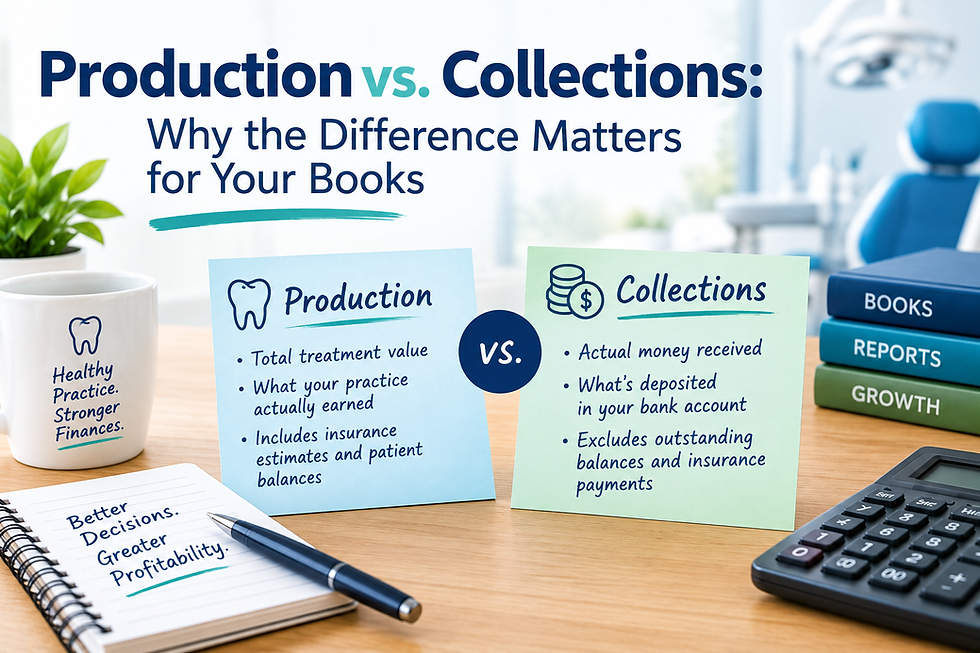
Production is the total value of the dentistry performed. It's what gets entered into your practice management software the moment a procedure is completed and coded, regardless of whether a dollar has actually changed hands yet.
Collections is the cash that actually lands in the bank. It reflects patient payments, insurance reimbursements, and any adjustments — write-offs, discounts, or insurance fee-schedule reductions — applied along the way.
Production tells you what the practice did. Collections tells you what the practice got paid for. They're rarely the same number in any given month, and that's normal — but the size and direction of the gap is where the useful information lives.
Why Production vs. Collections Matters More Than Either Number Alone
Looking at production or collections in isolation gives you half the picture. A practice can have record-high production and still run into cash flow trouble if collections lag behind. The reverse also happens: strong collections can mask a production slowdown for a month or two before the cash flow problem catches up.
Tracking the relationship between production and collections — usually expressed as a collection rate (collections ÷ production) — is what actually tells you whether the practice is running well. A healthy dental practice typically collects 95–98% of what it produces. Anything meaningfully below that is a signal worth investigating before it becomes a bigger problem.
What Causes a Widening Gap
A handful of things typically drive production and collections apart:
Insurance claim delays — Claims sitting in "pending" for 30, 60, or 90+ days inflate production without matching cash coming in.
Write-offs and adjustments — Insurance fee-schedule reductions and courtesy discounts reduce what's ever collectible, even though the full amount was recorded as production.
Slow patient pay — Large treatment plans with in-house payment arrangements spread collections out over months while the full production posts immediately.
Billing and coding errors — Claims that get denied and resubmitted delay collections further, and sometimes get written off entirely if they age out.
None of these are necessarily bad on their own — insurance delays and payment plans are just part of running a dental practice. The problem is when they go untracked, and the gap between the two numbers grows without anyone noticing until there's a cash crunch.
Why This Matters for Your Books Specifically
This is where bookkeeping and clinical reporting often disagree — and where a lot of confusion starts. Your practice management software (Dentrix, Eaglesoft, Open Dental) tracks production in real time, procedure by procedure. Your books, on the other hand, should reflect collections — actual cash received — because that's what determines real profitability, tax liability, and owner distributions.
If your bookkeeping is built off production numbers instead of collections, your financials will consistently overstate revenue and, by extension, overstate what's actually available for overhead, payroll, and owner compensation. This is a common cause of practices that look profitable on paper but feel cash-strapped in reality.
Accurate books require:
Revenue recognized on a collections basis (or accrual basis with AR properly tracked, not just production)
Insurance adjustments and write-offs booked correctly as they're applied, not lumped in as generic "expenses"
Monthly reconciliation between what practice management software reports and what actually hit the bank
Keeping an Eye on Both Numbers Going Forward
Production and collections aren't in competition — you need both, tracked side by side, to understand the health of the practice. Production tells you how the clinical side is performing. Collections tell you what that translates to in real dollars. The gap between them, tracked monthly, is often the earliest warning sign of a billing problem, an insurance issue, or a cash flow squeeze before it shows up anywhere else.
If you're not confident your books currently separate these two numbers correctly, that's a quick thing to check — and often an easy fix once it's identified.
Book a free discovery call and we'll take a look at your numbers together.
Comments